Wheel alignment is an important part of vehicle maintenance because the position of a car’s wheels affects tyre wear, steering behaviour and handling. When alignment angles move outside the vehicle manufacturer’s specifications, a car may pull to one side, develop uneven tyre wear or feel different through the steering wheel.
Alignment problems can develop gradually or appear after an impact. Hitting a pothole, striking a kerb or being involved in a collision can affect wheel geometry and suspension components. Because the changes are not always obvious from the driver’s seat, understanding the warning signs can help motorists identify problems before they lead to unnecessary tyre replacement or more serious handling concerns.
Wheel alignment is also often confused with wheel balancing. The two services address different problems. Alignment concerns the angles and geometry of the wheels and suspension, while balancing corrects uneven weight distribution in the tyre and wheel assembly.
What Is Wheel Alignment?
Wheel alignment is the process of checking and, where possible, adjusting the angles at which a vehicle’s wheels meet the road. The aim is to bring those angles back towards the manufacturer’s specified settings.
Modern alignment equipment can measure several geometric characteristics, including toe, camber and caster. The exact adjustment available depends on the vehicle’s suspension design.
Michelin explains that alignment relates to the vehicle’s suspension geometry rather than simply the tyre and wheel assembly. It also notes that incorrect alignment can contribute to uneven tyre wear, altered vehicle behaviour and reduced tyre life.
Correct geometry helps the vehicle track as intended and allows the tyres to maintain appropriate contact with the road. However, alignment equipment cannot repair a damaged suspension component. If worn or bent parts are responsible for the problem, those components may need to be repaired or replaced before accurate alignment can be achieved.
Wheel Alignment and the Main Alignment Angles
Three terms commonly appear when discussing wheel geometry: camber, caster and toe. Understanding them makes it easier to interpret an alignment report from a garage.
Camber
Camber describes the inward or outward tilt of a wheel when viewed from the front of the vehicle. Excessive positive or negative camber can influence how the tyre contacts the road surface.
When the geometry is significantly outside the manufacturer’s specification, the tread may wear more heavily on one side. Michelin identifies excessive one-sided shoulder wear as a possible indication of a camber-related alignment problem.
Toe
Toe describes the direction in which the wheels point when viewed from above. Wheels can be set with toe-in or toe-out depending on the vehicle’s design requirements.
Incorrect toe can have a noticeable effect on tyre wear because the tyres may not roll in the intended direction relative to the vehicle. This is one reason the term wheel tracking is often used when motorists talk about alignment.
Caster
Caster concerns the angle of the steering axis when viewed from the side. It contributes to steering behaviour and stability, although it is not adjustable on every vehicle.
Because different suspension designs provide different adjustment possibilities, technicians should assess alignment against the specifications for the particular vehicle rather than applying generic figures.
Wheel Alignment vs Wheel Balancing
Wheel balancing and alignment are separate services, even though both can influence how a car feels on the road.
Balancing addresses the distribution of weight around the tyre and wheel assembly. If the assembly is unbalanced, the driver may experience vibration, particularly at certain speeds. Small balancing weights can be fitted to the wheel to compensate for differences in mass distribution.
Alignment, by contrast, concerns wheel and suspension geometry. A vehicle can therefore have correctly balanced wheels while still suffering from poor alignment.
Michelin describes wheel balancing as correcting uneven mass distribution in the tyre and rim assembly, whereas alignment involves adjusting suspension-related wheel angles.
The distinction matters when diagnosing symptoms. A vibration at speed may point towards balancing or another mechanical issue, while uneven tyre wear or a vehicle that consistently pulls to one side may justify an alignment check.
What Is Wheel Tracking?
Wheel tracking is a common term used in Britain for wheel alignment, particularly when discussing the front wheels and toe settings. The terminology can vary between garages, but motorists are generally referring to the adjustment of wheel geometry.
The important point is not the label used by the workshop. Drivers should understand what the service includes and whether the garage is checking the alignment of the vehicle according to the relevant manufacturer’s specifications.
Some modern vehicles require four-wheel alignment measurements because the rear axle also contributes to the vehicle’s overall geometry. A front-only adjustment may not identify a problem affecting the rear of the vehicle.
Common Signs of Poor Wheel Alignment
Alignment problems can produce several noticeable symptoms, although none of these signs automatically proves that alignment is the cause.
The car pulls to one side
If a vehicle consistently drifts or pulls to one side on a reasonably level road, alignment may be one possible explanation. Tyre pressures, road camber, suspension problems and steering faults can also influence directional behaviour.
The UK Highway Code advises motorists to pay attention to steering and tyre condition and notes that excessive or uneven tyre wear can be caused by wheels being out of alignment.
The steering wheel is not centred
A steering wheel that remains noticeably off-centre while the vehicle travels straight can be a reason to have the steering and alignment checked. However, technicians should investigate the whole steering and suspension system rather than assuming alignment is the only possible cause.
Uneven tyre wear
Uneven wear is one of the most useful visual clues. A tyre that is significantly more worn on one shoulder than across the rest of the tread can indicate a geometry problem.
It is important to inspect all four tyres because rear-wheel alignment issues can sometimes be less obvious to the driver than front-wheel problems.
Changes in handling
If a vehicle suddenly feels different through corners or requires more steering correction than usual, it deserves investigation. Alignment can influence handling, but worn suspension, steering components, incorrect tyre pressure or tyre damage can create similar symptoms.
How Tyre Wear Can Reveal Alignment Problems
Tyre wear provides valuable information about how a vehicle is interacting with the road. A healthy tyre should wear reasonably consistently when pressures, suspension condition, driving conditions and alignment are appropriate.
Abnormal patterns can point towards different issues. Wear concentrated along one shoulder may suggest an alignment or suspension problem, while other patterns can be associated with incorrect inflation, braking issues or worn components.
The Highway Code specifically advises motorists to check tyre condition and notes that excessive or uneven wear can be caused by faults in braking or suspension systems or by wheels being out of alignment.
However, tyre wear should not be diagnosed in isolation. A professional inspection can determine whether the problem is actually caused by alignment or by a component that has developed excessive movement.
What Can Cause Wheel Alignment to Change?
Alignment does not necessarily remain perfect throughout a vehicle’s life. Road impacts and mechanical wear can alter geometry.
Potholes
Britain’s roads can expose vehicles to potholes and uneven surfaces. A significant impact can affect a wheel, tyre, steering component or suspension part.
Kerb impacts
Hitting a kerb, particularly at speed or at an awkward angle, can place substantial forces through the wheel and suspension. A car may continue driving normally while developing an alignment issue.
Suspension wear
Worn bushes, ball joints, track rods and other components can introduce movement into the suspension system. In such circumstances, an alignment adjustment alone may not solve the underlying problem.
Accidents and repairs
Collision damage can alter suspension geometry or the position of structural components. After significant accident damage, alignment measurements can form part of a wider inspection and repair process.
When Should You Have the Alignment Checked?
There is no single universal interval that applies to every vehicle. Instead, motorists should consider an alignment check when symptoms or circumstances suggest that geometry may have changed.
Useful occasions include:
- After hitting a significant pothole or kerb.
- After an accident or suspension repair.
- When the vehicle pulls noticeably to one side.
- When the steering wheel appears off-centre while driving straight.
- When tyres show unusual or uneven wear.
- When handling changes unexpectedly.
- When fitting new tyres if the previous set showed abnormal wear.
Michelin recommends checking alignment when motorists notice uneven tyre wear or changes in handling or steering, and also suggests checking alignment when new tyres are fitted.
Why Alignment Matters for Handling Performance
Handling performance depends on many interacting factors, including tyres, suspension, steering, brakes, vehicle weight and road conditions. Alignment is one part of that system.
When wheel angles are significantly outside the intended specifications, the vehicle may not behave as designed. It can affect how the tyres follow the road and how the vehicle responds to steering inputs.
Michelin notes that misalignment can alter vehicle behaviour and may result in poorer road holding, while the RAC similarly highlights alignment as relevant to safe driving, even tyre wear and vehicle handling.
This does not mean every handling problem is an alignment problem. Steering or suspension faults can be more serious and may require immediate attention. The UK’s MOT inspection manual includes detailed checks of steering components, steering play and the security and condition of steering linkages.
Wheel Alignment and Fuel Efficiency
Incorrect alignment can also influence rolling resistance. When tyres are not travelling in the intended direction relative to the vehicle, additional resistance can occur.
Michelin identifies excessive fuel consumption as one possible consequence of misalignment.
However, alignment should not be viewed primarily as a fuel-saving service. Tyre condition, tyre pressure, driving style, vehicle load, weather and many other factors influence fuel consumption. The strongest reason to address an alignment problem is to restore the vehicle’s intended geometry and prevent unnecessary tyre wear or handling problems.
How a Professional Alignment Check Works
A modern alignment service normally begins with an inspection rather than immediately adjusting the wheels. The technician may check tyre condition, pressures, steering and suspension components before placing the vehicle on alignment equipment.
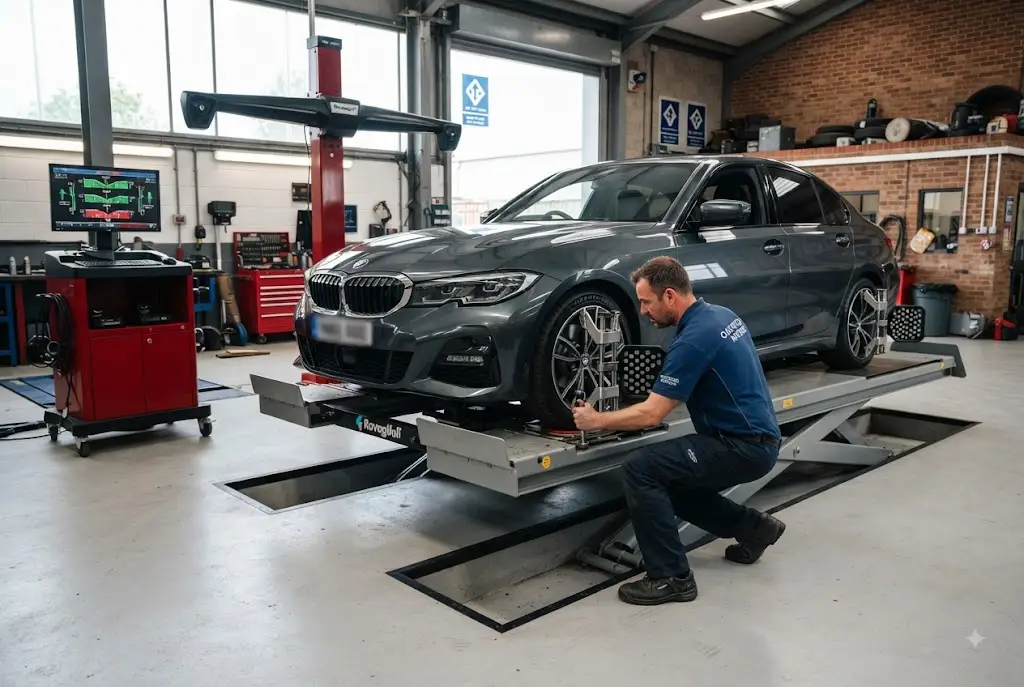
Sensors or cameras can then measure wheel angles and compare them with vehicle-specific specifications. Depending on the vehicle, the technician may adjust toe or other available alignment settings.
If measurements are outside specification but an adjustment cannot correct them, the workshop may need to investigate worn or damaged components. This is an important distinction because repeatedly adjusting alignment without addressing a mechanical fault may not provide a lasting solution.
A reputable garage should be able to explain what was measured, which settings were outside specification and what work was carried out.
Does Wheel Alignment Improve Tyre Life?
Correct alignment can help tyres wear more evenly and can reduce premature replacement caused by abnormal geometry. Michelin states that properly adjusted alignment helps optimise handling and tyre life.
This can be particularly valuable when a vehicle uses expensive specialist tyres. Uneven wear can shorten the useful life of a tyre even when the remaining tread would otherwise appear sufficient.
Nevertheless, alignment is only one part of tyre management. Correct inflation, suitable tyres, suspension condition and driving behaviour also affect tyre longevity.
Government guidance recommends checking tyre pressures regularly and keeping tyres correctly inflated to the manufacturer’s specification.
Wheel Alignment for Hybrid and Electric Vehicles
Wheel alignment remains relevant as Britain’s vehicle fleet becomes more electrified. Hybrid and electric vehicles still rely on tyres, steering and suspension, even though their powertrains differ from conventional petrol and diesel cars.
EVs can have substantial battery weight and different torque delivery characteristics, making correct tyre maintenance particularly important. Hybrid vehicles also combine electric propulsion with conventional mechanical systems, so alignment remains part of their broader maintenance requirements.
Our related hybrid servicing research examines how workshops are adapting to electrified vehicles, while EV servicing explores the specialist maintenance and technician requirements associated with battery-electric vehicles.
How Garage Chains and Independent Workshops Approach Alignment
Wheel alignment is offered by many types of automotive service business. Large garage chains may use alignment equipment across multiple branches, while independent garages can offer the same type of service where they have the necessary equipment and trained technicians.
The most important factor is not the size of the business but whether the workshop can accurately measure and adjust the vehicle according to the manufacturer’s requirements.
Customers can ask whether the service includes a full alignment check, whether the workshop provides before-and-after measurements and whether suspension or steering components will be inspected if the readings cannot be corrected through normal adjustment.
Wheel Alignment and Vehicle Safety
Safety studies and vehicle-maintenance guidance consistently emphasise the importance of tyres, steering and roadworthiness. Alignment is only one part of this picture, but abnormal geometry can affect handling and contribute to uneven tyre wear.
The UK government’s vehicle-safety guidance makes clear that drivers are responsible for ensuring their vehicles remain roadworthy, even if they have a current MOT certificate. It also states that tyre condition and tread requirements need regular attention.
The MOT system separately checks important steering, wheel, tyre and suspension components. However, an MOT should not be treated as a substitute for routine maintenance or an alignment check after an impact.
If a vehicle develops a sudden steering problem, severe tyre damage or significant changes in handling, motorists should have the vehicle assessed promptly rather than waiting for the next MOT.
How to Choose a Wheel Alignment Service
When comparing garages, motorists should look beyond the advertised price. A low-cost alignment check may not provide much value if the underlying suspension problem is not identified.
Useful questions include:
- Does the workshop use modern alignment equipment?
- Are measurements compared with the vehicle manufacturer’s specifications?
- Will the technician inspect steering and suspension components first?
- Will I receive alignment measurements before and after adjustment?
- Will the garage explain any readings that cannot be corrected?
These questions can help motorists understand whether they are purchasing a genuine diagnostic and adjustment service rather than simply paying for a quick steering adjustment.
The Role of Wheel Alignment in Modern Vehicle Maintenance
As vehicles become more sophisticated, basic mechanical maintenance remains important. Driver-assistance systems, advanced tyres and electronically controlled steering do not eliminate the need for sound suspension geometry.
In fact, maintaining the mechanical foundations of a vehicle can become even more important as modern systems depend on predictable vehicle behaviour. A car with worn suspension, damaged tyres or incorrect geometry may not perform as intended, regardless of how advanced its electronic systems are.
This is particularly relevant to the wider automotive service industry. Workshops need technicians who can understand traditional steering and suspension systems alongside increasingly sophisticated electronic technologies.
Final Thoughts on Wheel Alignment
Wheel alignment is a relatively straightforward maintenance service, but its effects can extend across tyre wear, steering response, handling and driving comfort. Problems may develop after pothole or kerb impacts, suspension wear or accidents, and the symptoms are not always immediately obvious.
The key warning signs include uneven tyre wear, a vehicle that pulls to one side, an off-centre steering wheel and unexpected changes in handling. These symptoms can have several possible causes, so a professional inspection is preferable to assuming alignment is responsible.
Wheel balancing should also be kept separate from alignment. Balancing addresses uneven weight distribution in the wheel and tyre assembly, while alignment concerns suspension and wheel geometry.
For UK motorists, regular tyre checks and sensible maintenance remain essential. Government guidance stresses the importance of correct tyre pressures, adequate tread and roadworthiness, while professional tyre and automotive organisations highlight the relationship between alignment, tyre life and handling.
Ultimately, correct alignment is not about making a vehicle look perfectly measured on a workshop screen. It is about ensuring the wheels and suspension are operating within the intended specifications so the vehicle can deliver predictable, efficient and safe road behaviour.