

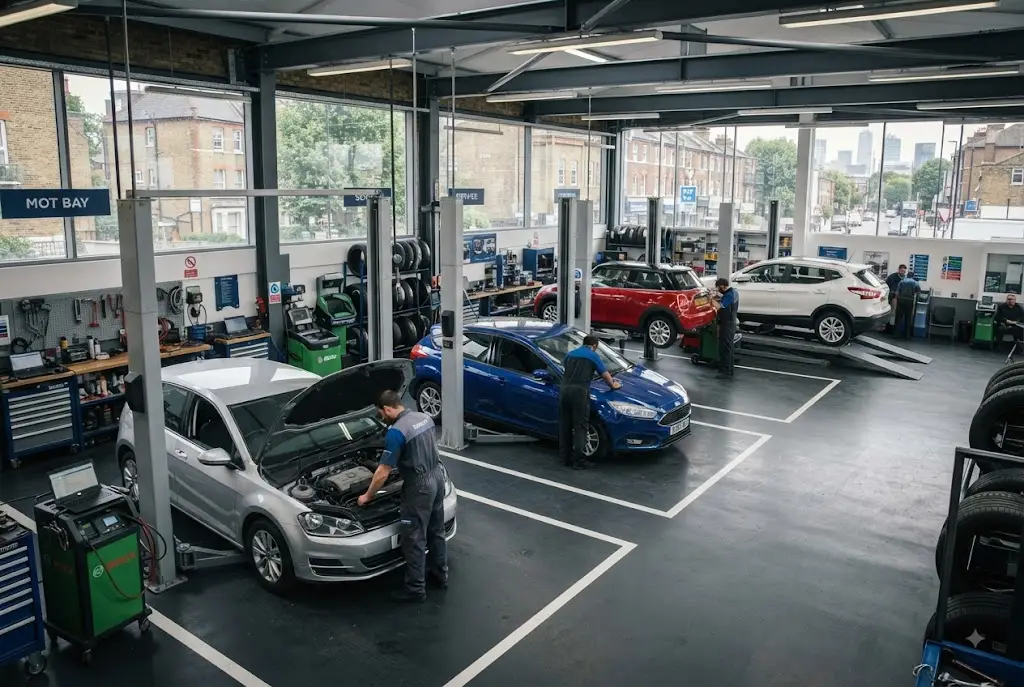
Britain’s garage chains play a major role in keeping millions of cars, vans and commercial vehicles on the road. From tyre fitting and MOT testing to servicing, brakes, diagnostics and accident repair, national and regional operators compete with independent garages for motorists’ business.
The market, however, is changing. Customers increasingly compare prices online, vehicles are becoming more technologically complex, and the transition towards hybrid and electric vehicles is changing what workshops need to invest in. At the same time, consolidation is reshaping parts of the automotive aftermarket, as larger operators expand through acquisitions while some established businesses reduce their physical footprint.
Looking at Britain’s garage chains therefore means looking beyond familiar high-street names. The competitive landscape includes large fast-fit networks, tyre specialists, autocentre groups, body-repair networks and smaller regional operators that compete through local reputation and specialist knowledge.
How Garage Chains Compete in Britain
The basic proposition behind a garage chain is straightforward: create a recognisable brand, build a network of workshops and provide motorists with convenient access to common vehicle services. Scale can support purchasing power, technician training, marketing and investment in equipment. A larger network can also make it easier to serve fleet operators and customers who travel between different parts of the country.
However, scale does not automatically guarantee a competitive advantage. A workshop still needs skilled technicians, appropriate diagnostic equipment, efficient parts supply and a strong local reputation. The customer ultimately experiences an individual branch, rather than the corporate structure behind it.
This creates an interesting tension between national consistency and local performance. A chain can establish common processes and service standards, while the quality of the customer experience can still vary between individual locations.
For motorists, the practical comparison is therefore not simply “chain versus independent”. It is about the particular service required, the competence of the workshop, pricing, convenience, warranty arrangements and the vehicle itself.
Kwik Fit and the Power of Network Scale
Kwik Fit remains one of the most recognisable names in the British fast-fit market. The company says it has more than 600 centres across the UK and Northern Ireland, providing services that extend well beyond tyre fitting. Its network includes MOT testing, servicing, brakes, batteries, exhausts, suspension and other vehicle maintenance work.
Its scale illustrates one of the biggest advantages available to established garage chains: geographical coverage. A customer does not necessarily need to build a relationship with one particular workshop when a familiar brand has locations across different towns and cities.
Kwik Fit has also invested in upgraded premises and workshop technology. Its centres include advanced wheel-alignment equipment, while its Kwik Fit Plus format is designed to handle more complex mechanical and electrical work.
That investment matters because the traditional fast-fit model is evolving. Modern vehicles increasingly depend on electronic systems, sensors and computer-controlled components. A chain that wants to remain competitive cannot rely solely on the traditional tyre, exhaust and brake model.
National Tyres and the Halfords Connection
National Tyres & Autocare occupies another important position in Britain’s automotive service landscape. Its network combines tyre fitting with broader autocare services, including MOTs and vehicle maintenance.
The relationship between National Tyres and Halfords is particularly relevant when examining consolidation. Halfords’ own Autocentres network and National Tyres operate within the same wider business, creating a substantial footprint in the UK aftermarket.
Halfords says its Autocentres network has around 600 locations, while its published service information covers routine servicing, MOT testing, brakes, batteries, tyres and other repairs. The company also promotes technician training and guarantees on qualifying parts and labour.
This illustrates how automotive groups can build scale by bringing different customer propositions and workshop networks under a broader corporate structure. For consumers, the result can be greater availability and a wider range of services. For competitors, however, large networks can increase pressure on pricing, marketing and local coverage.
Protyre and the Role of Tyre-Led Automotive Services
Protyre represents another important model in the UK market. Tyre specialists have traditionally had a strong position in fast-fit because tyres are a recurring and essential vehicle expense. Yet the commercial opportunity increasingly extends beyond the tyre itself.
Once a vehicle is inside a workshop, there are opportunities to provide related services such as wheel alignment, balancing, brakes, suspension checks, MOT testing and mechanical maintenance. This broader service mix can increase customer value while reducing reliance on individual tyre transactions.
Tyre-focused businesses also benefit from their expertise in areas that directly affect vehicle safety and performance. Tyre condition, correct inflation, wheel alignment and balancing can all influence how a vehicle behaves on the road.
For a deeper look at one of these technical areas, our upcoming coverage of wheel alignment will examine steering alignment, tyre wear, handling and the reasons motorists may need professional adjustment.
ATS Euromaster Shows How Competitive Pressure Can Reshape a Network
One of the most significant recent developments in Britain’s garage-chain market has been the exit of ATS Euromaster from UK operations.
ATS Euromaster had been a major fast-fit operator, but in 2026 it moved to wind down its UK business after restructuring efforts failed to produce a sustainable route back to profitability. The company had already closed a substantial number of underperforming locations before deciding that continued operation in the UK was no longer viable.
The change demonstrates that a large physical network can also become a financial challenge. Property costs, staffing, equipment investment, competition and changing customer behaviour all affect whether individual workshops generate sufficient returns.
The ATS situation also produced a further example of consolidation. Formula One Autocentres acquired 35 former ATS sites, helping expand its own network, while another group of locations was transferred to S&M Tyres, which trades as Elite Garages.
Formula One Autocentres has subsequently positioned itself for further expansion. Its network now includes former ATS locations, demonstrating how market exits can create opportunities for stronger competitors to acquire useful sites, customers and trained staff.
Formula One and Fast Fit Autocentres Highlight Regional Competition
Formula One Autocentres is particularly interesting because it competes as a large independent operator rather than relying on the ownership structure of a major vehicle manufacturer or tyre producer. The company describes itself as family owned and says it has more than 170 branches across England.
Its service range covers tyres, brakes, exhausts, batteries, clutches, MOT testing and servicing. The business also promotes investment in technician training and workshop technology.
The phrase Fast Fit Autocentres can also describe smaller regional operators rather than one single national business. For example, independent fast-fit businesses in different parts of Britain compete by combining MOTs, servicing, tyres, repairs and local customer relationships. Croxdale Fast Fit Autocentres operates six locations across County Durham and Tyne & Wear, while Fast Fit Autocentre in Cwmbran provides servicing, repairs, MOTs, tyres and mobile tyre fitting in its regional market.
This regional layer is important. Britain’s automotive aftermarket is not controlled exclusively by national chains. Strong local operators can remain competitive by offering personal service, specialist knowledge, flexible pricing and long-term relationships with motorists and fleet customers.
Fix Auto Represents a Different Type of Garage Network
Fix Auto should also be considered when investigating Britain’s garage networks, although its business model differs from the typical fast-fit chain. It specialises primarily in accident and collision repair rather than routine servicing and tyre replacement.
Fix Auto UK operates through a network of locally owned and managed body repair businesses. Its UK network has expanded beyond 130 locations, and the company states that its body shops operate to British Standard BS 10125.
The model demonstrates another way that automotive businesses can achieve network scale. Instead of owning every workshop directly, a branded network can provide independent operators with centralised support, technical training, insurance relationships, processes and brand recognition.
That structure is especially relevant in body repair, where relationships with insurers and fleet operators can be just as important as direct consumer demand.
Why Market Competition Is Becoming More Complicated
Britain’s market competition between garage chains is no longer based simply on who can offer the cheapest tyre or MOT. Several structural changes are influencing the industry at the same time.
Online price comparison
Motorists can now compare tyre prices, servicing packages and workshop reviews before making an appointment. This makes transparency increasingly important and reduces the advantage of simply having a familiar name on a high street.
Technology and diagnostics
Modern vehicles require increasingly sophisticated diagnostic tools. Garage chains need to invest in equipment and technician training if they want to service newer vehicles effectively.
Electric and hybrid vehicles
The transition away from conventional petrol and diesel vehicles is creating new requirements for workshops. Hybrid systems, high-voltage components, battery technology and electric drivetrains require different knowledge from traditional mechanical servicing.
Our related research into hybrid servicing will explore how workshops are adapting to hybrid ownership, while the planned EV servicing coverage will examine electric vehicle maintenance, EV technicians and the industry’s readiness for a larger electric fleet.
Technician availability
A garage network is only as strong as the people operating its workshops. Recruiting and retaining qualified technicians is therefore becoming a strategic issue, particularly as the technical requirements of modern vehicles become more demanding.
Are Garage Chains Better Than Independent Garages?
There is no universal answer. A large chain can offer extensive opening hours, national coverage, standardised processes, online booking and recognised warranty arrangements. These benefits can be particularly useful for motorists who value convenience or fleet operators that need consistent service across multiple regions.
An independent garage can offer something different. Local businesses may build strong personal relationships with customers and develop specialist knowledge of particular vehicle types or local driving conditions. They may also have greater flexibility when dealing with unusual repairs.
The right choice depends on the job. A straightforward tyre replacement may be suitable for many different workshop types, while a complex electrical fault or specialist repair may require a technician with particular expertise.
Consumers should therefore compare the actual service being offered rather than relying solely on the size of the brand.
What the Future Holds for Britain’s Garage Chains
The next stage of the British automotive aftermarket is likely to involve continued consolidation alongside competition from independent workshops. The ATS Euromaster exit demonstrates that network scale alone cannot protect a business from weak economics, while the subsequent expansion of Formula One and Protyre-related operations shows how attractive locations and customer demand can be redistributed between stronger operators.
At the same time, major brands such as Kwik Fit and Halfords have incentives to keep investing in workshop technology, technician training and broader service capabilities. Body-repair networks such as Fix Auto demonstrate that franchising and network models can also provide another route to scale.
Perhaps the biggest change will come from vehicle technology. Hybrid and electric cars are gradually altering the type of work workshops perform. Garage chains that invest early in training, diagnostics and high-voltage vehicle capability may be better positioned as the vehicle parc evolves.
Final Thoughts on Britain’s Garage Chains
Britain’s garage chains are entering a period in which scale, technology, location and customer trust all matter. Kwik Fit, National Tyres & Autocare, Halfords, Protyre, Fix Auto and Formula One illustrate different approaches to building automotive service networks, while regional fast-fit businesses show that independent competition remains significant.
The recent changes surrounding ATS Euromaster also provide a useful reminder that the market is not static. Businesses can expand, consolidate, restructure or leave the market altogether as operating costs and customer demand change.
For motorists, this creates more choice but also makes informed comparison more important. The strongest garage is not necessarily the biggest one. It is the workshop that combines appropriate technical expertise, transparent pricing, suitable equipment and dependable service for the specific vehicle and repair required.
